



Abstract
Ptah is building a launch platform on BNB Chain where creators choose how a token reaches its community. The first proposed launch paths are direct trading with pool-level taxes and NFT-based mining, in which Relics are woven into Looms and Looms receive token emissions. They are starting points for a broader template system, with room for additional distribution mechanisms, AI features, and ideas proposed by the community.
The platform provides tools; it does not decide for creators. Within published bounds, a project can choose its own reserves, team allocation, liquidity share, and emission schedule. The website's role is transparency: it shows each project's token distribution, flags concentrated allocations, and labels .AI-identity projects separately from ordinary-wallet projects.
The design separates standard tokens, trading rules, and project mechanics. Project terms are fixed when configured; pool terms are fixed when the pool is created. $PTAH is intended to pay project creation fees. After Genesis mining ends, holders are planned to be able to forge Looms into Founder NFTs, intended as long-term credentials of participation in the platform.
This paper describes the direction of the platform, not a statement that every capability is live. Ptah Genesis is the existing Relic and Loom experience, whose public sale has ended. Launch contracts, the token transition, Founder NFTs, and broader AI capabilities are in development and remain proposed until their release is announced and their deployed state can be verified.
1. From a first collection to a launch platform
A launch is more than the creation of a token. It decides who can participate, how supply enters circulation, what funds liquidity, and how creators are paid. Those choices should be readable before participation and remain understandable after trading begins.
Ptah began with a concrete sequence: mint a Relic, weave ten Relics into a Loom, and receive $PTAH through mining. The platform direction makes launch mechanics reusable. A creator selects a template, configures the permitted terms, and establishes a market on a shared trading foundation.
"Weave ideas into markets" connects that origin to the broader product. Weaving is both an existing action and a way to describe assembling a launch. The platform is intended to accommodate different communities and release methods without requiring every project to follow the Genesis sequence.
2. The principles behind a launch
Creators choose; the website discloses
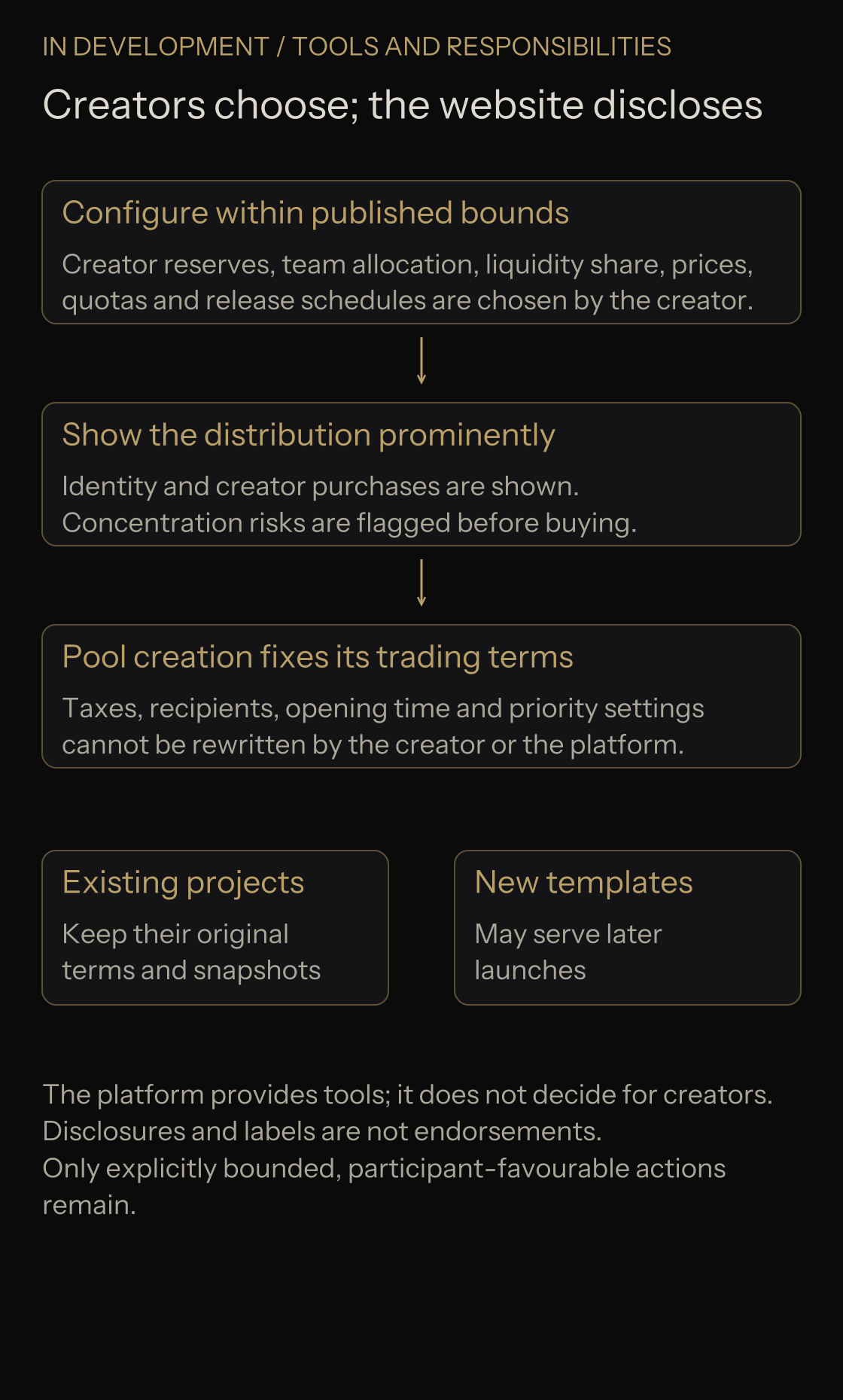
Creators may configure substantial reserves and team allocations within published bounds. The website shows distribution and concentration notices. Configuration fixes project terms, pool creation fixes pool terms, and new templates do not rewrite existing projects.
IN DEVELOPMENT / TOOLS AND RESPONSIBILITIES Creators choose; the website discloses
Configure within published bounds
Creator reserves, team allocation, liquidity share, prices, quotas and release schedules are chosen by the creator.
Show the distribution prominently
Identity and creator purchases are shown. Concentration risks are flagged before buying.
Pool creation fixes its trading terms
Taxes, recipients, opening time and priority settings cannot be rewritten by the creator or the platform.
Existing projects
Keep their original terms and snapshots
New templates
May serve later launches
The platform provides tools; it does not decide for creators. Disclosures and labels are not endorsements. Only explicitly bounded, participant-favourable actions remain.
Creators may configure substantial reserves and team allocations within published bounds. The website shows distribution and concentration notices. Configuration fixes project terms, pool creation fixes pool terms, and new templates do not rewrite existing projects.
Open full-size vector diagram (opens in a new tab)The platform provides tools. Communities distribute tokens in different ways. Some projects want broad public participation; others need to hold a larger share themselves and distribute it through partners, promoters, or their own programs. Ptah does not judge which approach is right. Creators may configure substantial reserves, a larger team NFT allocation, the share of proceeds that enters liquidity, and their emission schedule, all within published bounds.
The website is responsible for transparency. Every project page shows, prominently, how supply is divided: the creator's reserve, the team NFT share, the share of mint proceeds committed to liquidity, and any creator purchase at launch. Projects with concentrated allocations carry a visible risk notice before a participant buys. Each project is labelled as an .AI-identity project or an ordinary-wallet project, based on the creator's status recorded at creation. Labels and notices are disclosures, not endorsements.
Standard tokens. The proposed platform tokens have a fixed supply minted at creation, with no administrator, later minting authority, transfer tax, or blacklist. Wallets, explorers, and aggregators see an ordinary token. Trading rules belong to the designated pool rather than the token's transfer function.
Terms that stay put. Project settings are recorded once, with only explicitly bounded follow-up actions, each of which can only move in a direction favourable to participants. Pool taxes, recipients, opening time, and priority-allocation settings are fixed at pool creation; no one, including the creator or the platform, can change them afterwards. Platform parameter changes apply only to later projects or pools.
Bounded flexibility. Every configurable value has a hard upper and lower limit written into the contracts. Some limits are technical, some protect participants, and some reflect product choices. Values outside the bounds are refused on-chain. When bounds change, new templates are released; existing projects keep their original terms.
Separate responsibilities. Minting, weaving, mining, and NFT bids live in project contracts. Trading rules live in the pool hook. Claims and NFT-market actions should not depend on the continued operation of a trading pool.
3. More than one way to launch
Two starting points, more possibilities
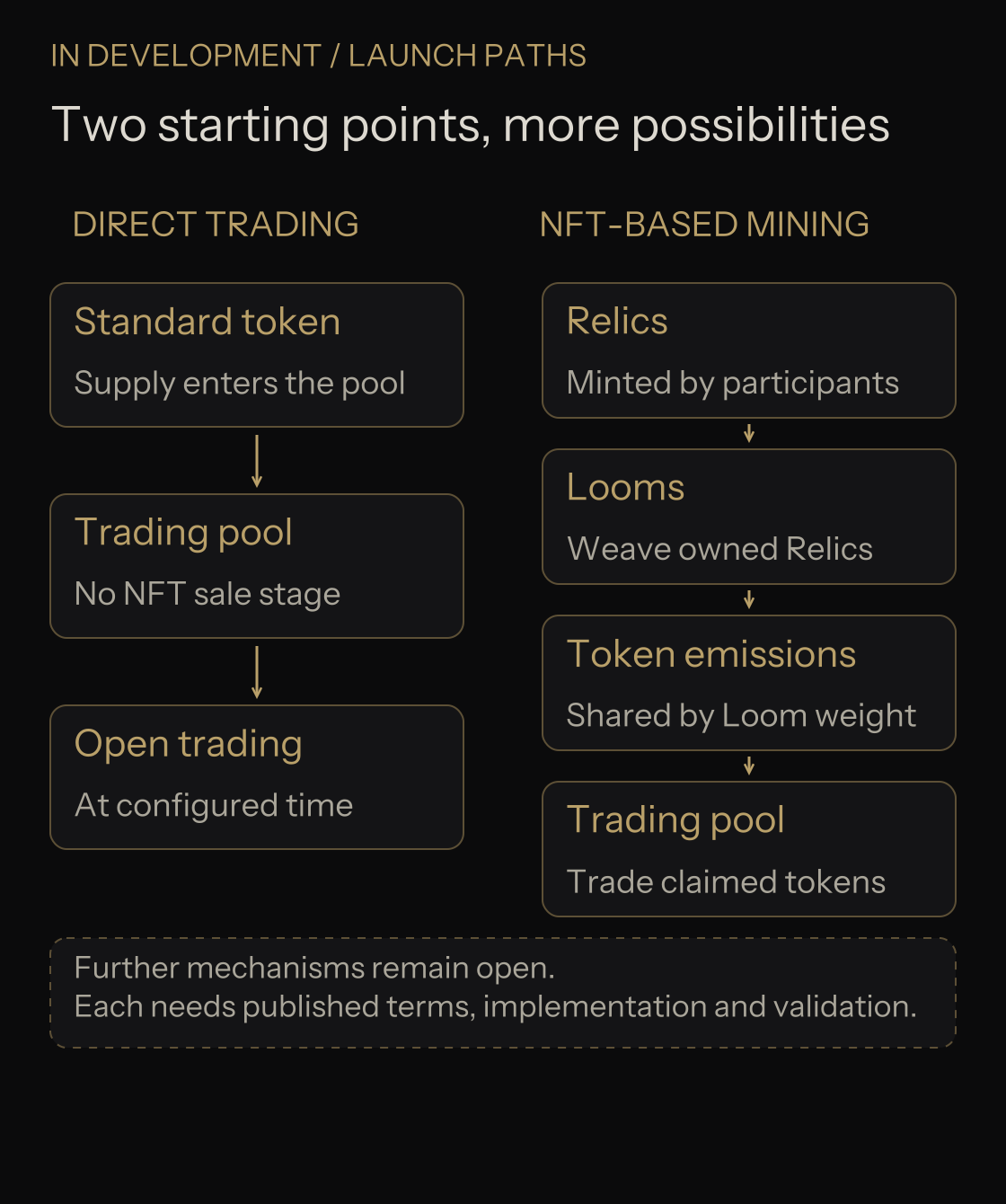
Proposed direct trading creates a standard token and trading pool without an NFT-sale phase. Proposed mining uses Relics, Looms and scheduled token emissions. Further templates remain open.
IN DEVELOPMENT / LAUNCH PATHS Two starting points, more possibilities
DIRECT TRADING
Standard token
Supply enters the pool
Trading pool
No NFT sale stage
Open trading
At configured time
NFT-BASED MINING
Relics
Minted by participants
Looms
Weave owned Relics
Token emissions
Shared by Loom weight
Trading pool
Trade claimed tokens
Further mechanisms remain open.
Each needs published terms, implementation and validation.
Proposed direct trading creates a standard token and trading pool without an NFT-sale phase. Proposed mining uses Relics, Looms and scheduled token emissions. Further templates remain open.
Open full-size vector diagram (opens in a new tab)The initial design includes two launch families. Both use the proposed PancakeSwap Infinity trading foundation and the same fixed token supply for every project. Neither defines the limit of what Ptah may support.
Direct trading
A direct launch places the token supply into a trading pool and opens trading at the configured time. It requires no NFT sale, bonding-curve phase, or graduation threshold. Creation, pool setup, liquidity placement, the permanent liquidity lock, and an optional creator purchase happen together when the project is configured. After that, the creator holds no on-chain controls over the pool. Creator revenue comes from the project's trading tax and the trading fees earned by the locked position.
An optional creator purchase can occur in the same transaction as pool creation. It pays the applicable trading tax, is subject to a published limit, and is shown on the project page. It is not an untaxed allocation.
NFT-based mining
Disclose where the token supply goes
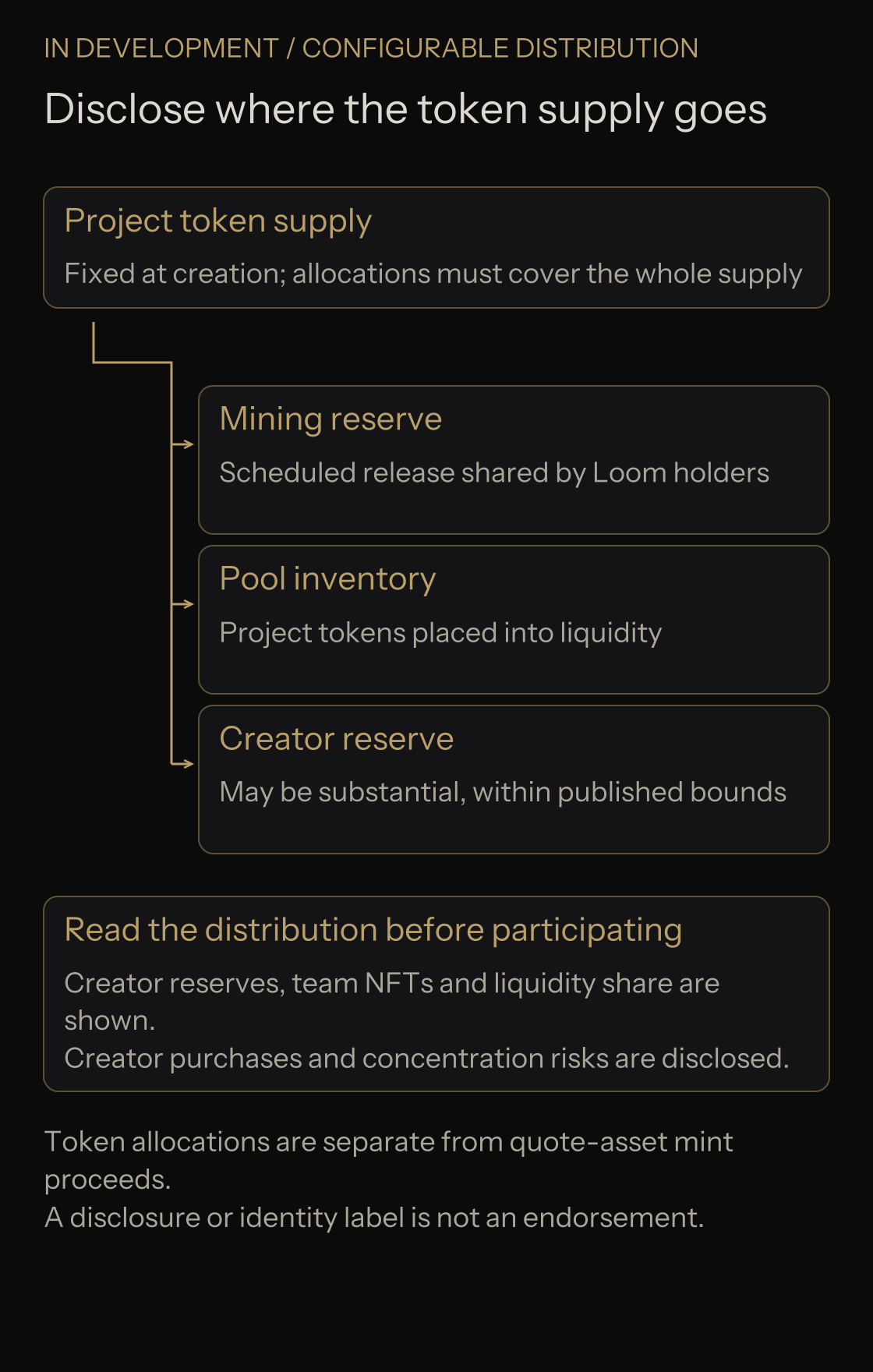
The creator configures token shares for mining, pool inventory and creator reserve within published bounds. Reserves and team allocations may be substantial. The website discloses these shares and flags concentration before participation.
IN DEVELOPMENT / CONFIGURABLE DISTRIBUTION Disclose where the token supply goes
Project token supply
Fixed at creation; allocations must cover the whole supply
Mining reserve
Scheduled release shared by Loom holders
Pool inventory
Project tokens placed into liquidity
Creator reserve
May be substantial, within published bounds
Read the distribution before participating
Creator reserves, team NFTs and liquidity share are shown. Creator purchases and concentration risks are disclosed.
Token allocations are separate from quote-asset mint proceeds. A disclosure or identity label is not an endorsement.
The creator configures token shares for mining, pool inventory and creator reserve within published bounds. Reserves and team allocations may be substantial. The website discloses these shares and flags concentration before participation.
Open full-size vector diagram (opens in a new tab)Read the mining and creator schedules
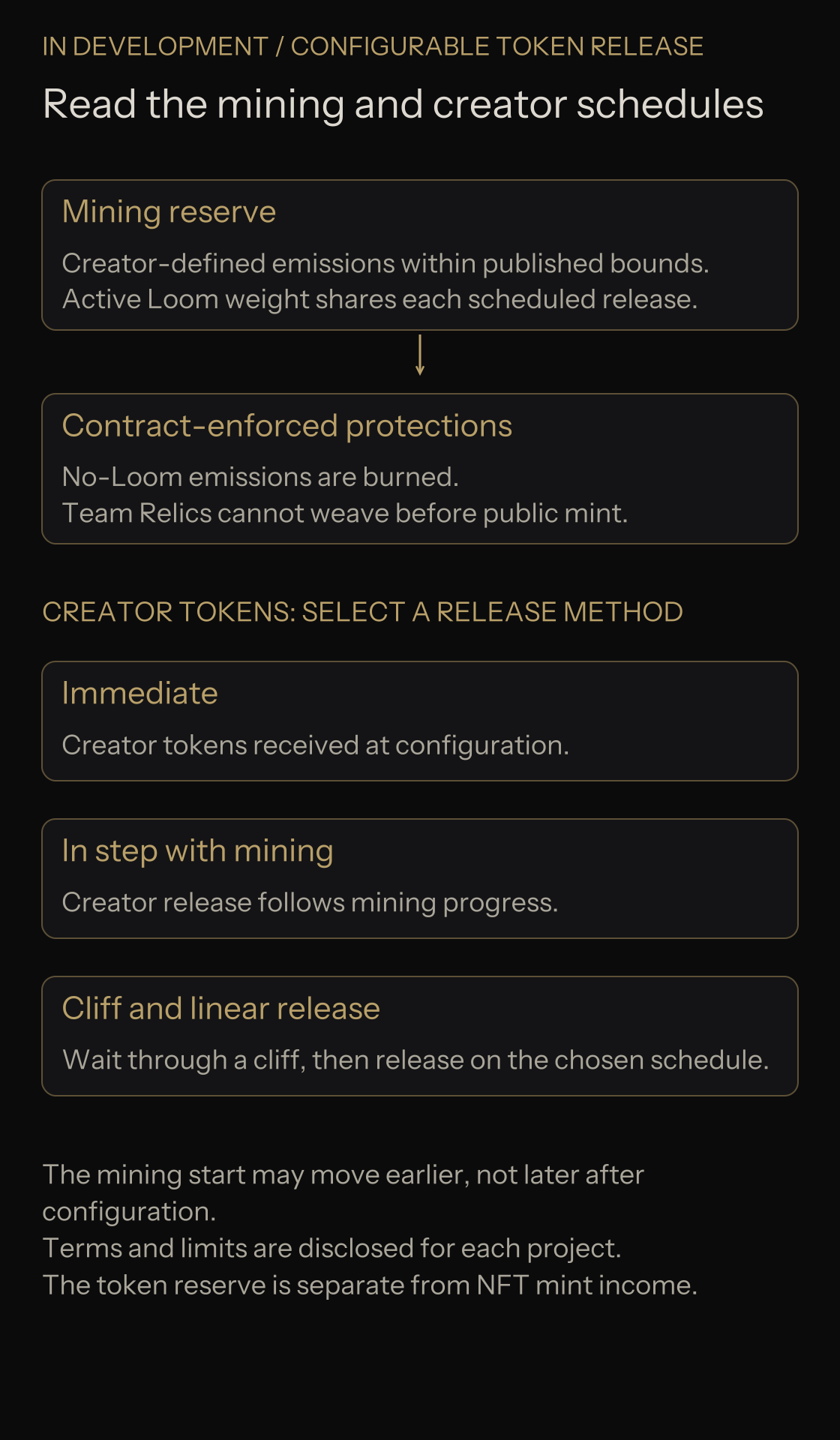
The creator configures mining emissions and selects immediate, mining-progress, or cliff-and-linear release of creator tokens, within published bounds. No-Loom emissions are burned; team Relics cannot weave before public mint. Mining start can only move earlier.
IN DEVELOPMENT / CONFIGURABLE TOKEN RELEASE Read the mining and creator schedules
Mining reserve
Creator-defined emissions within published bounds. Active Loom weight shares each scheduled release.
Contract-enforced protections
No-Loom emissions are burned. Team Relics cannot weave before public mint.
CREATOR TOKENS: SELECT A RELEASE METHOD
Immediate
Creator tokens received at configuration.
In step with mining
Creator release follows mining progress.
Cliff and linear release
Wait through a cliff, then release on the chosen schedule.
The mining start may move earlier, not later after configuration. Terms and limits are disclosed for each project. The token reserve is separate from NFT mint income.
The creator configures mining emissions and selects immediate, mining-progress, or cliff-and-linear release of creator tokens, within published bounds. No-Loom emissions are burned; team Relics cannot weave before public mint. Mining start can only move earlier.
Open full-size vector diagram (opens in a new tab)Participants mint Relics, weave a configured number of owned Relics into a Loom, and accrue project tokens according to the mining schedule and their share of Loom weight. More Looms divide the same scheduled release among more weight.
At configuration the creator sets, within published bounds:
- the edition: a fixed edition, or a timed open edition with a deadline; unsold supply expires at the deadline, with no automatic refund or extension;
- prices and quotas, including free minting, and whether minting is limited to .AI identities or shared between identity holders and ordinary wallets;
- the weaving ratio of Relics per Loom;
- the token split between mining, pool inventory, and the creator, which must add up to the whole supply;
- the team Relic allocation;
- the share of paid mint proceeds committed to liquidity, which cannot fall below a platform minimum;
- the emission schedule;
- how the creator's own tokens are released: immediately, in step with mining progress, or on a cliff-and-linear schedule.
Some protections are enforced by the contracts regardless of configuration. Team Relics cannot be woven before the public mint opens. Emissions from periods without any Looms are sent to be burned rather than saved for later arrivals. After configuration, the mining start can move earlier but not later. Holders can use a bid-based NFT market in which buyers lock funds in bids and sellers choose which bid to fill; locked bid funds can leave only through cancellation by the buyer or a fill.
Weaving, claiming, and NFT-market actions never require an .AI identity. Holders should not need eligibility to retrieve what they already own.
Space for further mechanisms
Future templates may explore additional pricing, allocation, sale, or reveal mechanisms. These are areas for development, not an announced release list. Each addition needs its own published behaviour, limits, implementation, and validation.
Mechanics driven by minting or time can remain in project contracts. A mechanic triggered by each swap may require a different pool hook, with separate review and distribution requirements. New templates serve new launches while preserving the terms of projects already created.
4. The trading plug-in
The token and the pool have different roles
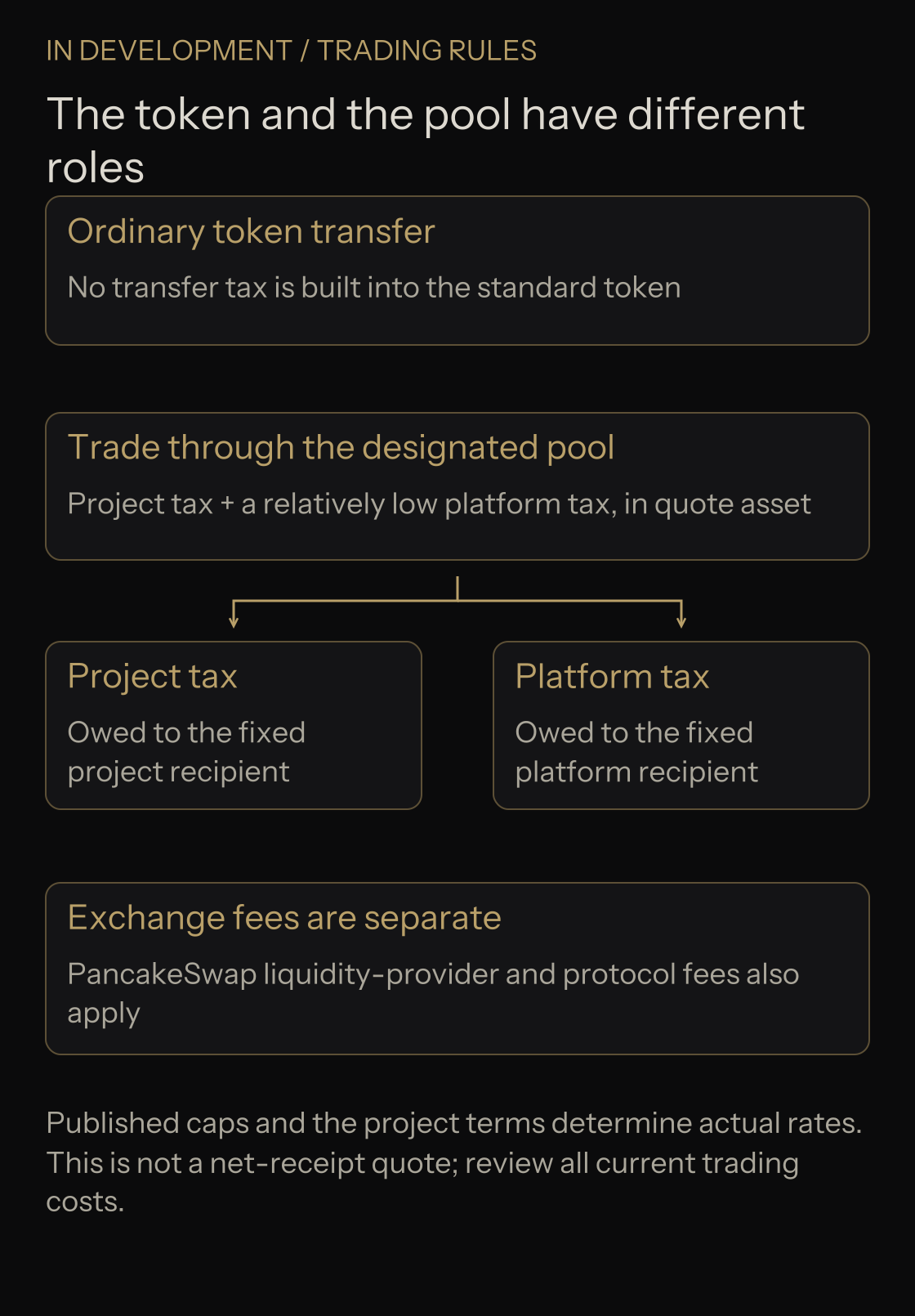
Standard wallet transfers have no token transfer tax. The designated trading pool applies project and platform tax in BNB or USDT. PancakeSwap liquidity-provider and protocol fees are separate, and actual rates follow published project terms.
IN DEVELOPMENT / TRADING RULES The token and the pool have different roles
Ordinary token transfer
No transfer tax is built into the standard token
Trade through the designated pool
Project tax + a relatively low platform tax, in quote asset
Project tax
Owed to the fixed project recipient
Platform tax
Owed to the fixed platform recipient
Exchange fees are separate
PancakeSwap liquidity-provider and protocol fees also apply
Published caps and the project terms determine actual rates. This is not a net-receipt quote; review all current trading costs.
Standard wallet transfers have no token transfer tax. The designated trading pool applies project and platform tax in BNB or USDT. PancakeSwap liquidity-provider and protocol fees are separate, and actual rates follow published project terms.
Open full-size vector diagram (opens in a new tab)Opening tax and payout are separate
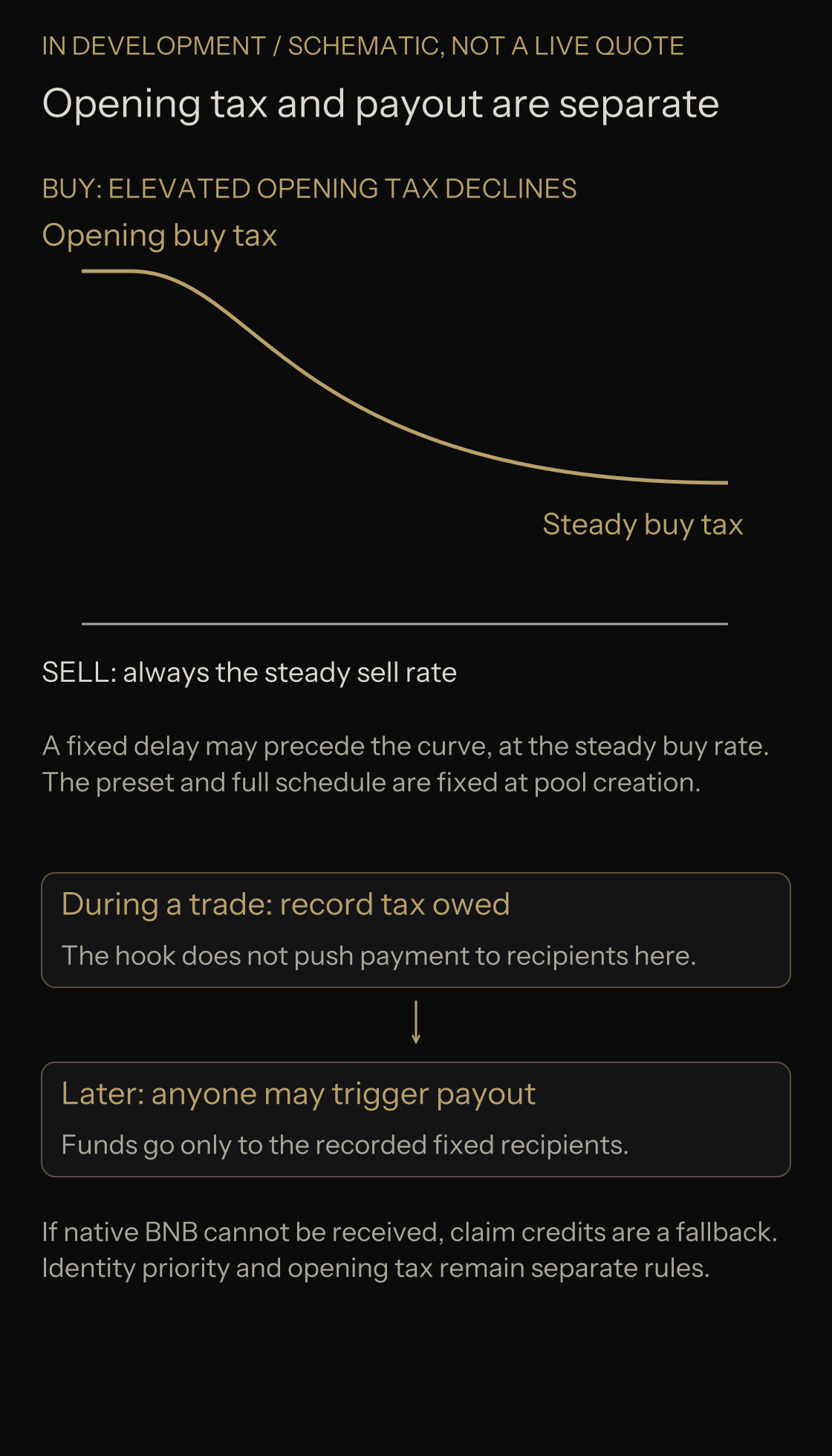
An illustrative opening buy-tax curve falls from an elevated rate to its steady rate. Sells always use their steady rate. A fixed delay may precede the curve. Trading records tax owed, and anyone can later trigger payout to fixed recipients, with native-asset claim credits as a fallback.
IN DEVELOPMENT / SCHEMATIC, NOT A LIVE QUOTE Opening tax and payout are separate BUY: ELEVATED OPENING TAX DECLINES Opening buy tax Steady buy tax SELL: always the steady sell rate A fixed delay may precede the curve, at the steady buy rate. The preset and full schedule are fixed at pool creation.
During a trade: record tax owed
The hook does not push payment to recipients here.
Later: anyone may trigger payout
Funds go only to the recorded fixed recipients.
If native BNB cannot be received, claim credits are a fallback. Identity priority and opening tax remain separate rules.
An illustrative opening buy-tax curve falls from an elevated rate to its steady rate. Sells always use their steady rate. A fixed delay may precede the curve. Trading records tax owed, and anyone can later trigger payout to fixed recipients, with native-asset claim credits as a fallback.
Open full-size vector diagram (opens in a new tab)Identity priority controls early access
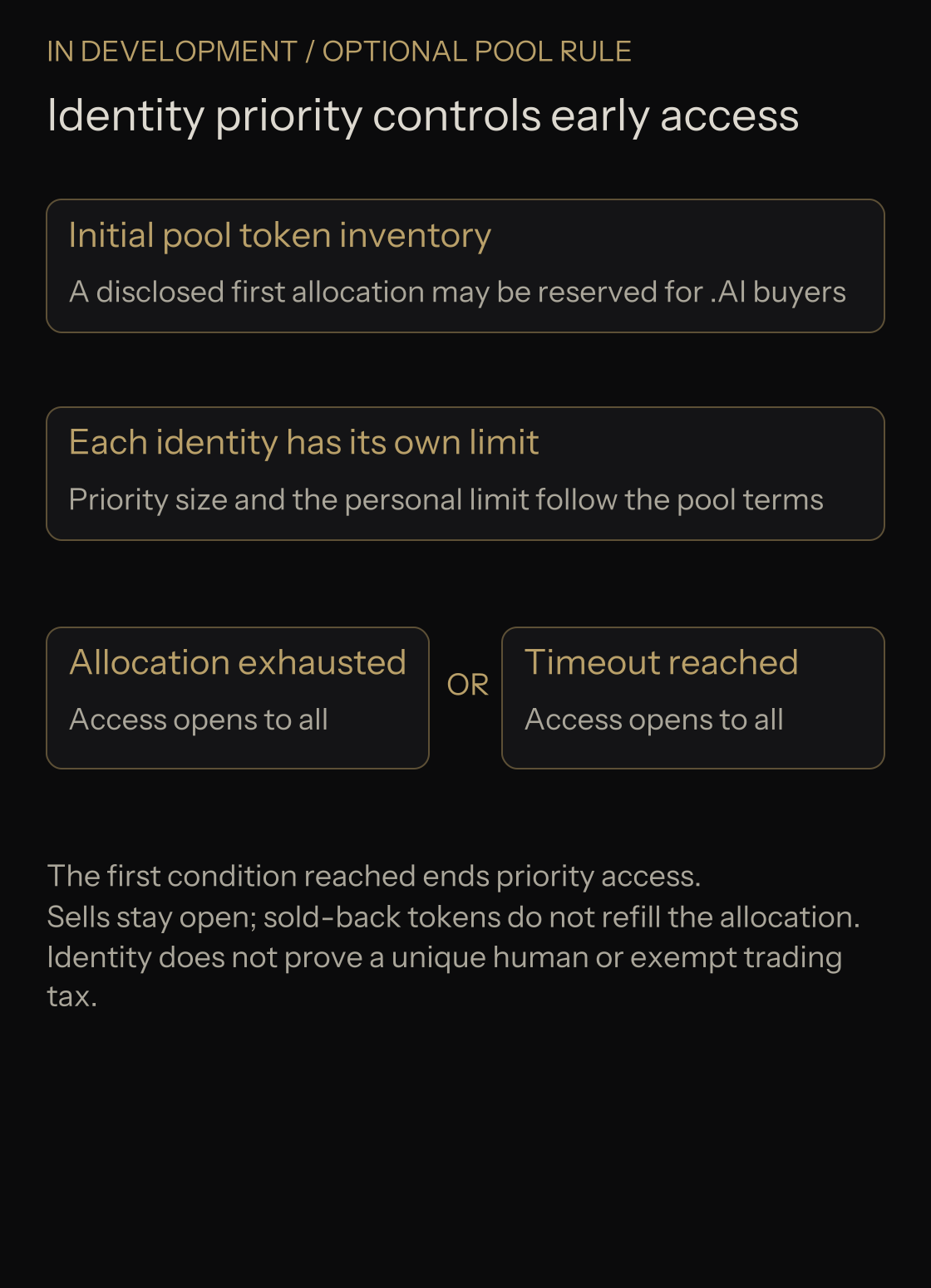
An optional first pool allocation is reserved for .AI buyers, with a personal limit. Access opens when that allocation is exhausted OR a short timeout passes. Sells remain open, sold-back tokens do not refill priority, and an identity does not prove a unique human or waive tax.
IN DEVELOPMENT / OPTIONAL POOL RULE Identity priority controls early access
Initial pool token inventory
A disclosed first allocation may be reserved for .AI buyers
Each identity has its own limit
Priority size and the personal limit follow the pool terms
Allocation exhausted
Access opens to all
Timeout reached
Access opens to all
OR The first condition reached ends priority access. Sells stay open; sold-back tokens do not refill the allocation. Identity does not prove a unique human or exempt trading tax.
An optional first pool allocation is reserved for .AI buyers, with a personal limit. Access opens when that allocation is exhausted OR a short timeout passes. Sells remain open, sold-back tokens do not refill priority, and an identity does not prove a unique human or waive tax.
Open full-size vector diagram (opens in a new tab)The proposed platform uses a single shared hook on PancakeSwap Infinity: a plug-in attached to each pool that applies the launch's trading rules on every buy and sell.
Tax is collected in the pool, in the quote asset. Projects choose BNB or USDT as the quote asset, and trading taxes are collected in that asset. A recipient therefore never has to sell the project token simply to receive tax revenue. This does not remove selling pressure from holders, emissions, or creator allocations. Adding or removing liquidity is not taxed, and ordinary wallet transfers are not taxed by the token.
A platform tax and a project tax. Each trade carries the project's own tax and a relatively low platform tax. The combined steady-state rate is capped by a published limit written into the hook.
A high opening tax that declines. A pool can use fixed buy and sell taxes, or an opening buy tax that starts very high and falls over a short period to the steady rate. The opening curve targets automated sniping in the first moments of trading. Sells always use the steady rate, so people who already hold tokens are not locked in. The curve's start may be delayed for a fixed interval, during which only the steady tax applies. The platform offers a small set of presets; creators cannot write custom curves. The full schedule is fixed at pool creation and can be displayed in advance.
Identity-first allocation. A pool may reserve the first part of its token inventory for buyers holding a Binance .AI identity, with a per-identity limit. The window opens to everyone once the allocation is exhausted or after a short timeout. Sells remain open throughout, and tokens sold back do not refill the allocation. The priority window and the opening tax are separate rules; holding an identity does not exempt a buyer from opening taxes. Identity limits are not proof that every participant is a unique human or independent operator. During the window, smart-contract wallets and third-party aggregators may be unable to buy; they work normally afterwards.
Collection separated from payout. During a trade, the hook only records the amount owed to each fixed recipient; it does not push payment. Anyone may later trigger distribution, but cannot change where it goes. If a recipient cannot receive native BNB, an equivalent PancakeSwap claim credit is available as a fallback. This keeps a recipient's receiving behaviour from blocking any swap.
Separate from exchange fees. PancakeSwap liquidity-provider and protocol fees are separate from trading taxes. External protocol changes can affect the total cost later, and platform immutability statements do not remove PancakeSwap's own powers.
Only approved pool creators. The hook refuses pools created outside the platform's designated path, so a creator cannot choose a private opening price or attach a second taxed pool to the same token.
5. Liquidity and creator revenue
A paid mint has separate cash destinations
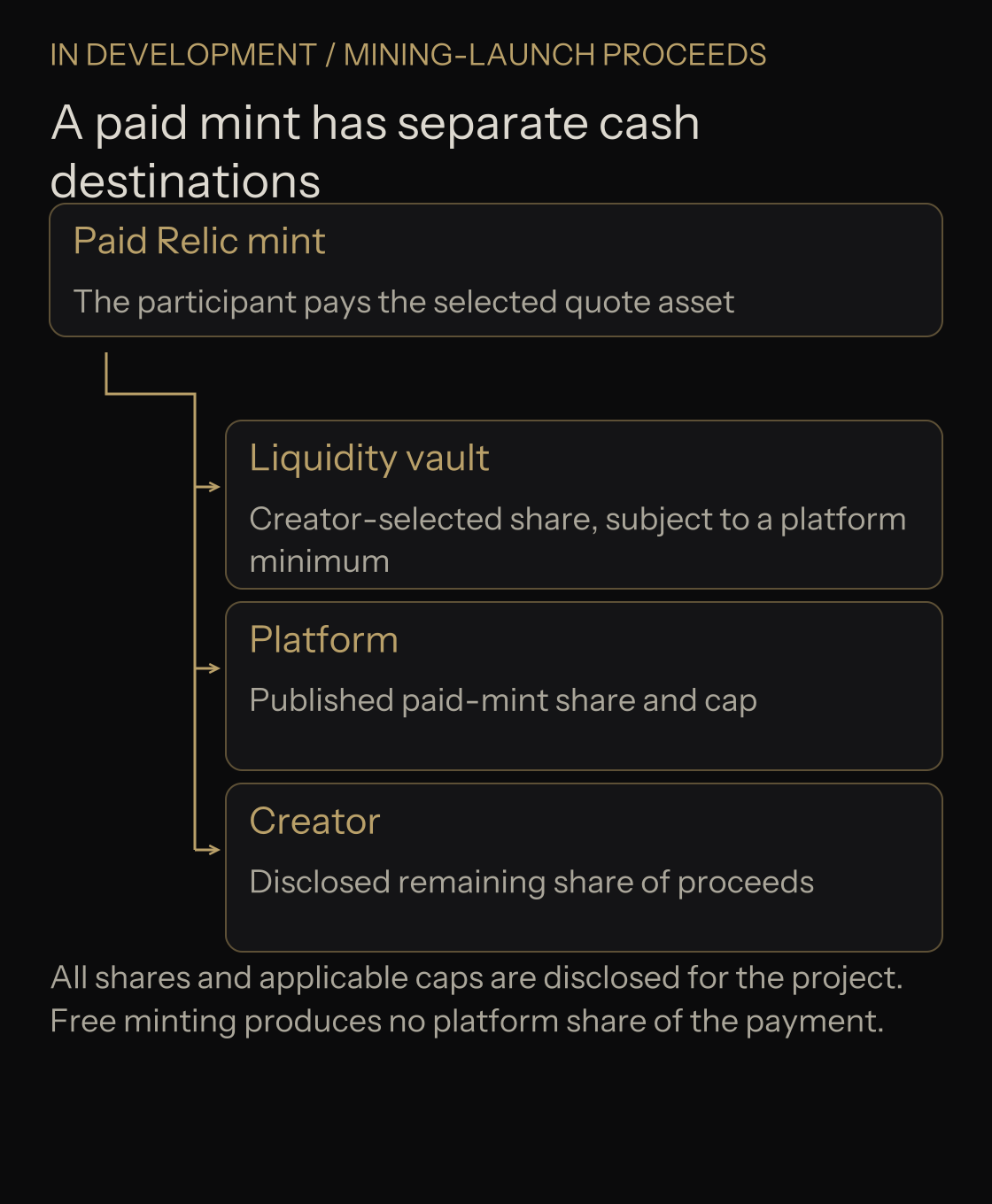
A paid mint divides the quote-asset payment between the project liquidity vault, platform and creator. The creator chooses liquidity within published bounds. Free minting has no platform payment share.
IN DEVELOPMENT / MINING-LAUNCH PROCEEDS A paid mint has separate cash destinations
Paid Relic mint
The participant pays the selected quote asset
Liquidity vault
Creator-selected share, subject to a platform minimum
Platform
Published paid-mint share and cap
Creator
Disclosed remaining share of proceeds
All shares and applicable caps are disclosed for the project. Free minting produces no platform share of the payment.
A paid mint divides the quote-asset payment between the project liquidity vault, platform and creator. The creator chooses liquidity within published bounds. Free minting has no platform payment share.
Open full-size vector diagram (opens in a new tab)From the liquidity vault to an open pool
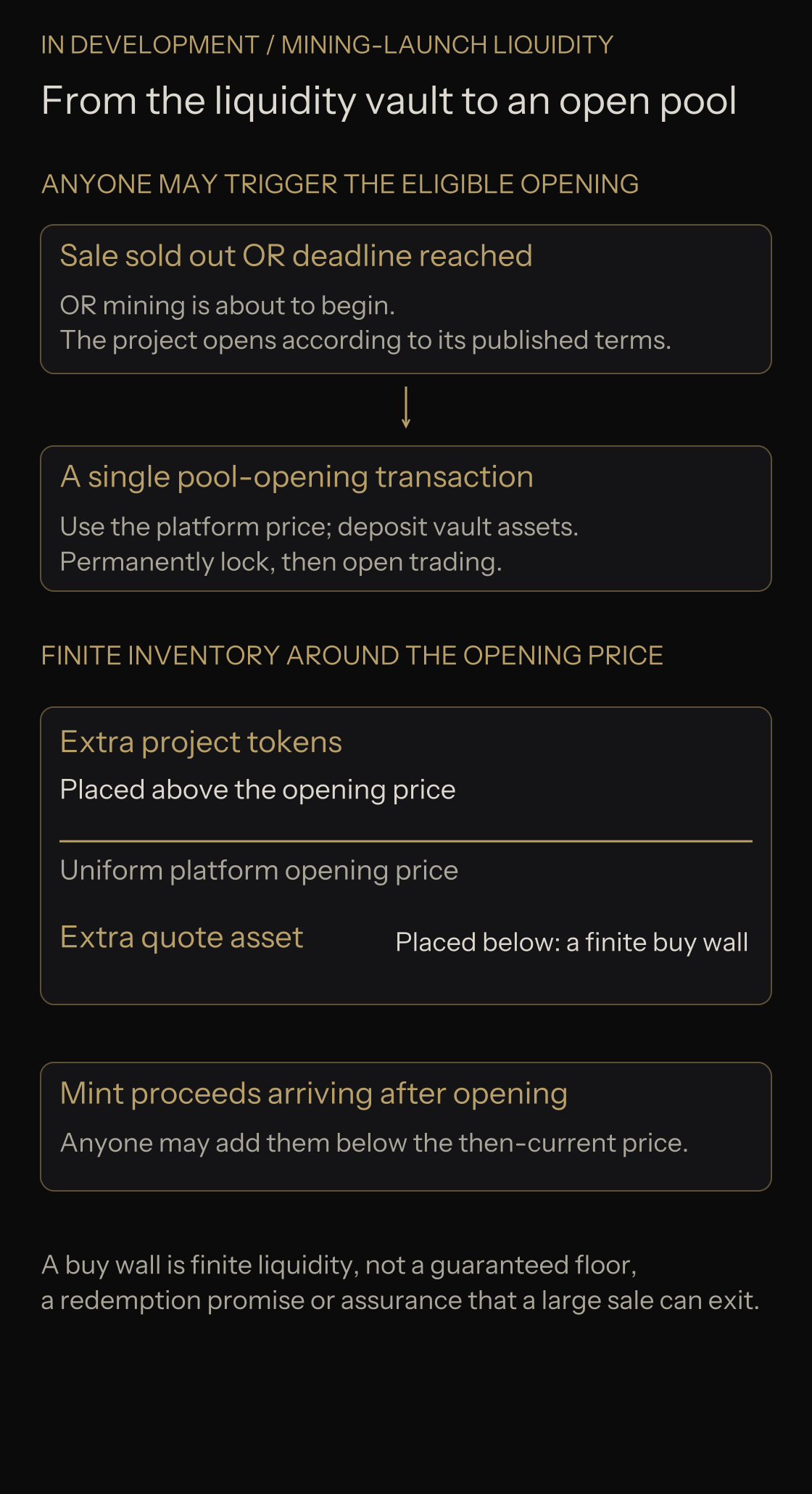
A mining project opens when sold out, its deadline arrives, or mining is about to begin. One transaction adds vault assets at the uniform platform opening price, permanently locks liquidity and opens trading. Surplus quote assets sit below the opening price; surplus tokens above. Later proceeds can be added below current price. This is not a guaranteed floor.
IN DEVELOPMENT / MINING-LAUNCH LIQUIDITY From the liquidity vault to an open pool ANYONE MAY TRIGGER THE ELIGIBLE OPENING
Sale sold out OR deadline reached
OR mining is about to begin. The project opens according to its published terms.
A single pool-opening transaction
Use the platform price; deposit vault assets. Permanently lock, then open trading.
FINITE INVENTORY AROUND THE OPENING PRICE
Extra project tokens
Placed above the opening price Uniform platform opening price Extra quote asset Placed below: a finite buy wall
Mint proceeds arriving after opening
Anyone may add them below the then-current price.
A buy wall is finite liquidity, not a guaranteed floor, a redemption promise or assurance that a large sale can exit.
A mining project opens when sold out, its deadline arrives, or mining is about to begin. One transaction adds vault assets at the uniform platform opening price, permanently locks liquidity and opens trading. Surplus quote assets sit below the opening price; surplus tokens above. Later proceeds can be added below current price. This is not a guaranteed floor.
Open full-size vector diagram (opens in a new tab)For new platform launches, the design calls for permanent liquidity-position locks with no principal-withdrawal function. The lock may distribute earned trading fees to the pool's designated recipient. Locking a position does not guarantee its value, a minimum token price, or the ability to exit at a particular size.
In a mining launch, each paid mint is divided at once between the project's liquidity vault, the platform, and the creator. The liquidity share is chosen by the creator, subject to a platform minimum. Free mints incur no platform share.
Anyone can trigger a mining project's pool opening once the sale is sold out, its deadline has arrived, or mining is about to begin. A single transaction creates the pool at the platform's uniform opening price, deposits vault funds and project tokens, permanently locks the position, and opens trading. Excess quote assets are placed below the opening price, forming a buy wall; excess project tokens are placed above it. This is an arrangement of finite inventory, not a guaranteed price floor, redemption promise, or assurance that a large sale can exit. Mint proceeds arriving after opening can be added by anyone below the then-current price.
Creator revenue may include a disclosed share of mint proceeds, project trading taxes, trading fees earned by the locked position, and NFT-market fees. A tax configuration or revenue stream is not an assurance of trading activity or profit.
6. $PTAH and platform fees
PTAH is intended to pay creation fees
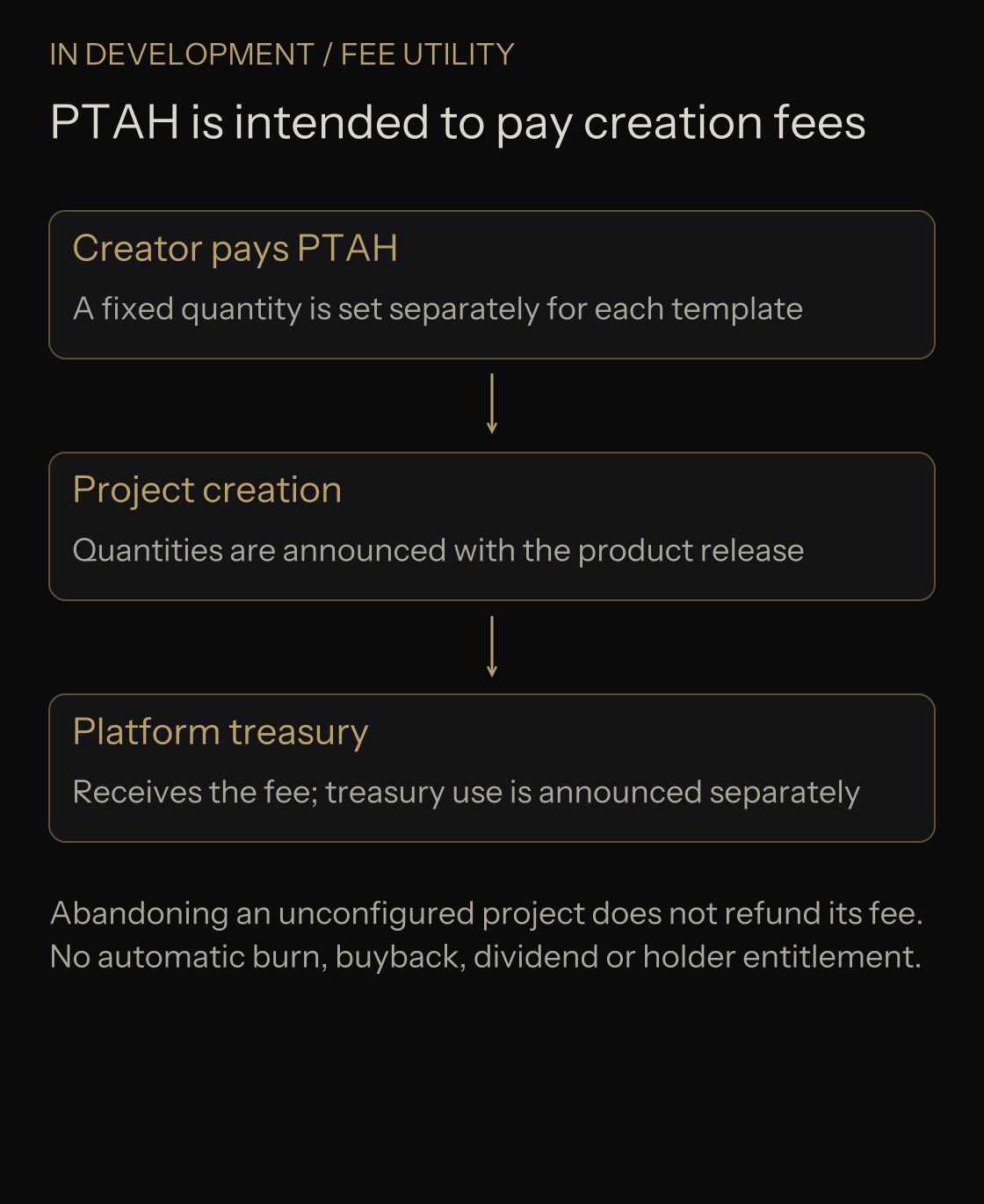
A creator pays a fixed PTAH quantity to create a project, and the fee goes to the platform treasury. Quantities and treasury use will be announced separately. Abandonment does not refund the fee. No automatic burn, buyback or holder revenue right is promised.
IN DEVELOPMENT / FEE UTILITY PTAH is intended to pay creation fees
Creator pays PTAH
A fixed quantity is set separately for each template
Project creation
Quantities are announced with the product release
Platform treasury
Receives the fee; treasury use is announced separately
Abandoning an unconfigured project does not refund its fee. No automatic burn, buyback, dividend or holder entitlement.
A creator pays a fixed PTAH quantity to create a project, and the fee goes to the platform treasury. Quantities and treasury use will be announced separately. Abandonment does not refund the fee. No automatic burn, buyback or holder revenue right is promised.
Open full-size vector diagram (opens in a new tab)$PTAH is intended to be the payment asset for project creation fees. A fixed quantity of PTAH is charged when a project is created, set separately by template, and paid to the platform treasury. Quantities will be announced with the product release. Creation fees are not refunded if a creator abandons an unconfigured project, and they also deter mass creation of empty projects. A future convenience tool may let creators pay in BNB or USDT, converted to PTAH before the fee is paid; that tool is outside the initial core contracts.
The platform's other revenues are a share of paid NFT mints and a relatively low platform trading tax. Each has a published cap. The platform can adjust them, but changes apply only to projects configured or pools created afterwards; the snapshot of an existing project or pool keeps its original terms. Specific rates will be published with the product release.
The use of PTAH received by the platform treasury will be announced separately. No automatic burn, buyback, dividend, governance right, or revenue entitlement for PTAH holders is promised by this paper.
7. Founder NFT
Forge a Founder NFT
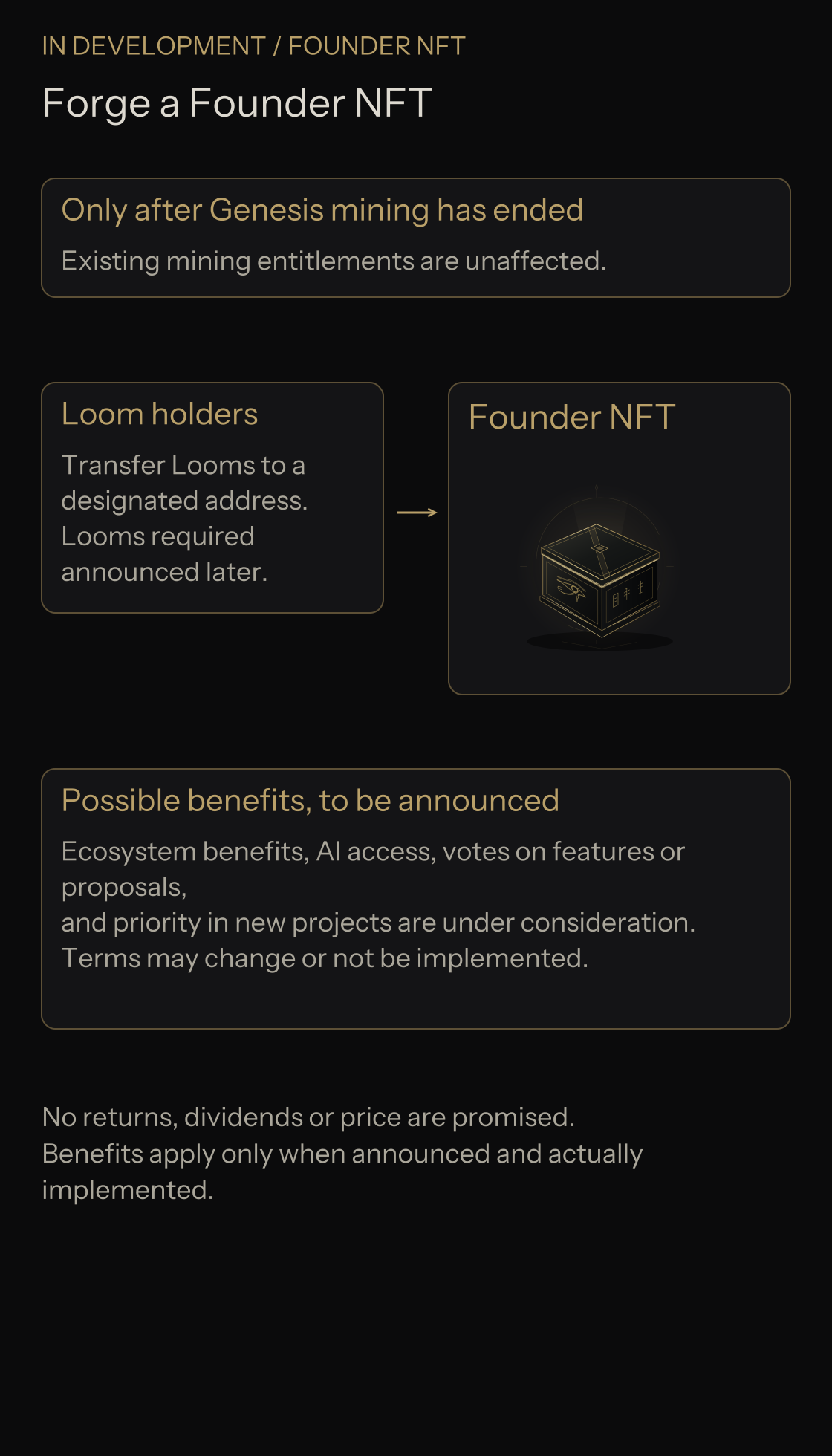
Planned after Genesis mining ends: holders may transfer Looms to a designated address to forge a Founder NFT. The Loom count is to be announced. Founder is intended as a long-term participation credential; possible benefits remain undefined and may change or not be implemented. It does not promise returns, dividends or price.
IN DEVELOPMENT / FOUNDER NFT Forge a Founder NFT
Only after Genesis mining has ended
Existing mining entitlements are unaffected.
Loom holders
Transfer Looms to a designated address. Looms required announced later.
Founder NFT
Possible benefits, to be announced
Ecosystem benefits, AI access, votes on features or proposals, and priority in new projects are under consideration. Terms may change or not be implemented.
No returns, dividends or price are promised. Benefits apply only when announced and actually implemented.
Planned after Genesis mining ends: holders may transfer Looms to a designated address to forge a Founder NFT. The Loom count is to be announced. Founder is intended as a long-term participation credential; possible benefits remain undefined and may change or not be implemented. It does not promise returns, dividends or price.
Open full-size vector diagram (opens in a new tab)After Genesis mining ends, holders are planned to be able to forge Looms into a Founder NFT by transferring them to a designated address. The number of Looms per Founder NFT will be announced later. Forging opens only after mining has finished, so it does not affect any Loom's mining entitlement.
The Founder NFT is intended as the long-term credential of participation in the Ptah platform. Benefits under consideration include platform ecosystem benefits, access to AI features, votes on new features and proposals, and priority participation in new platform projects. The list is not exhaustive. Specific benefits, rules, and how they take effect will be set out in later announcements, and may change or not be implemented.
A Founder NFT is not a promise of returns, dividends, or price. Any benefit applies only as and when it is announced and implemented.
8. AI: platform capabilities and community proposals
Community ideas can become new tools
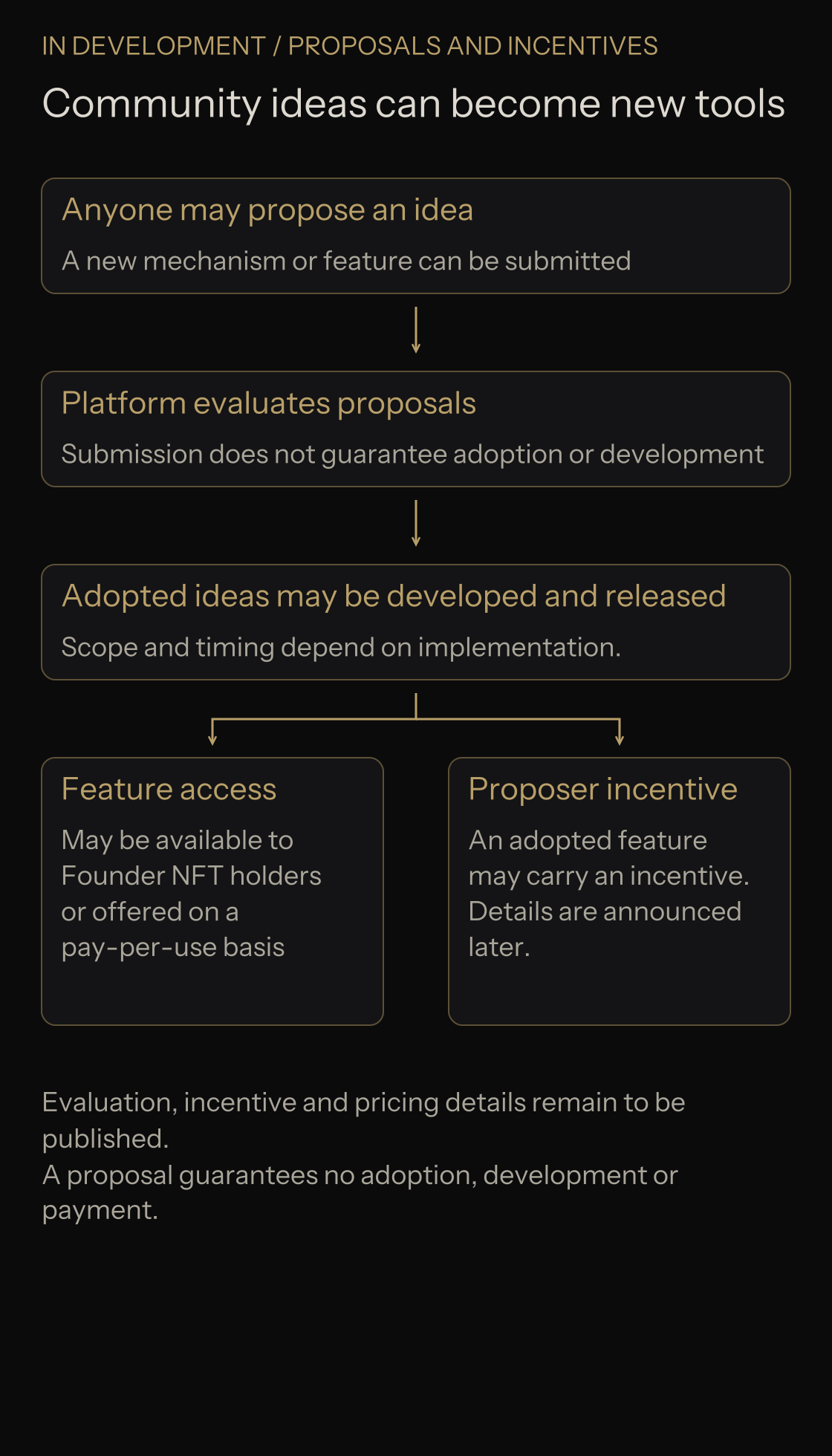
Anyone can propose a mechanism or feature. The platform evaluates ideas and may develop and release adopted proposals. Features may be offered to Founder NFT holders or on a pay-per-use basis; proposers may receive an incentive. Evaluation, pricing and incentive terms are to be announced. No adoption, development or payment is guaranteed.
IN DEVELOPMENT / PROPOSALS AND INCENTIVES Community ideas can become new tools
Anyone may propose an idea
A new mechanism or feature can be submitted
Platform evaluates proposals
Submission does not guarantee adoption or development
Adopted ideas may be developed and released
Scope and timing depend on implementation.
Feature access
May be available to Founder NFT holders or offered on a pay-per-use basis
Proposer incentive
An adopted feature may carry an incentive. Details are announced later.
Evaluation, incentive and pricing details remain to be published. A proposal guarantees no adoption, development or payment.
Anyone can propose a mechanism or feature. The platform evaluates ideas and may develop and release adopted proposals. Features may be offered to Founder NFT holders or on a pay-per-use basis; proposers may receive an incentive. Evaluation, pricing and incentive terms are to be announced. No adoption, development or payment is guaranteed.
Open full-size vector diagram (opens in a new tab)Binance .AI identity is a participation signal already present in Ptah. A launch may use it for creator eligibility, mint eligibility, or an opening purchase allocation. These are different controls. The platform records the creator's identity status when a project is created rather than retroactively changing that history.
Ptah provides AI features as part of the platform. Its existing tools include an Agent identity explorer and a wallet-connected chat experience. Further directions include helping people understand launches, explore mechanisms, interpret project information, and interact with on-chain tools. The presence of these tools does not imply that an Agent can create, trade, or manage any launch autonomously. Scope, providers, models, permissions, and release sequencing are not fixed by this whitepaper. Any action-taking capability must describe what it can do, what the user authorises, and how outcomes are verified. AI output is not a guarantee of correctness or investment performance.
Community proposals. Anyone can propose a new mechanism or feature. The platform evaluates proposals, develops the ones it adopts, and releases them, so that Ptah keeps gaining new capabilities built from community ideas. A released feature may be available to Founder NFT holders or offered on a pay-per-use basis. The proposer of an adopted feature may receive a corresponding incentive. Incentive, evaluation, and pricing details will be published later. Submitting a proposal does not guarantee adoption, development, or any payment.
9. Genesis keeps its own history
Genesis weaving and mining weight
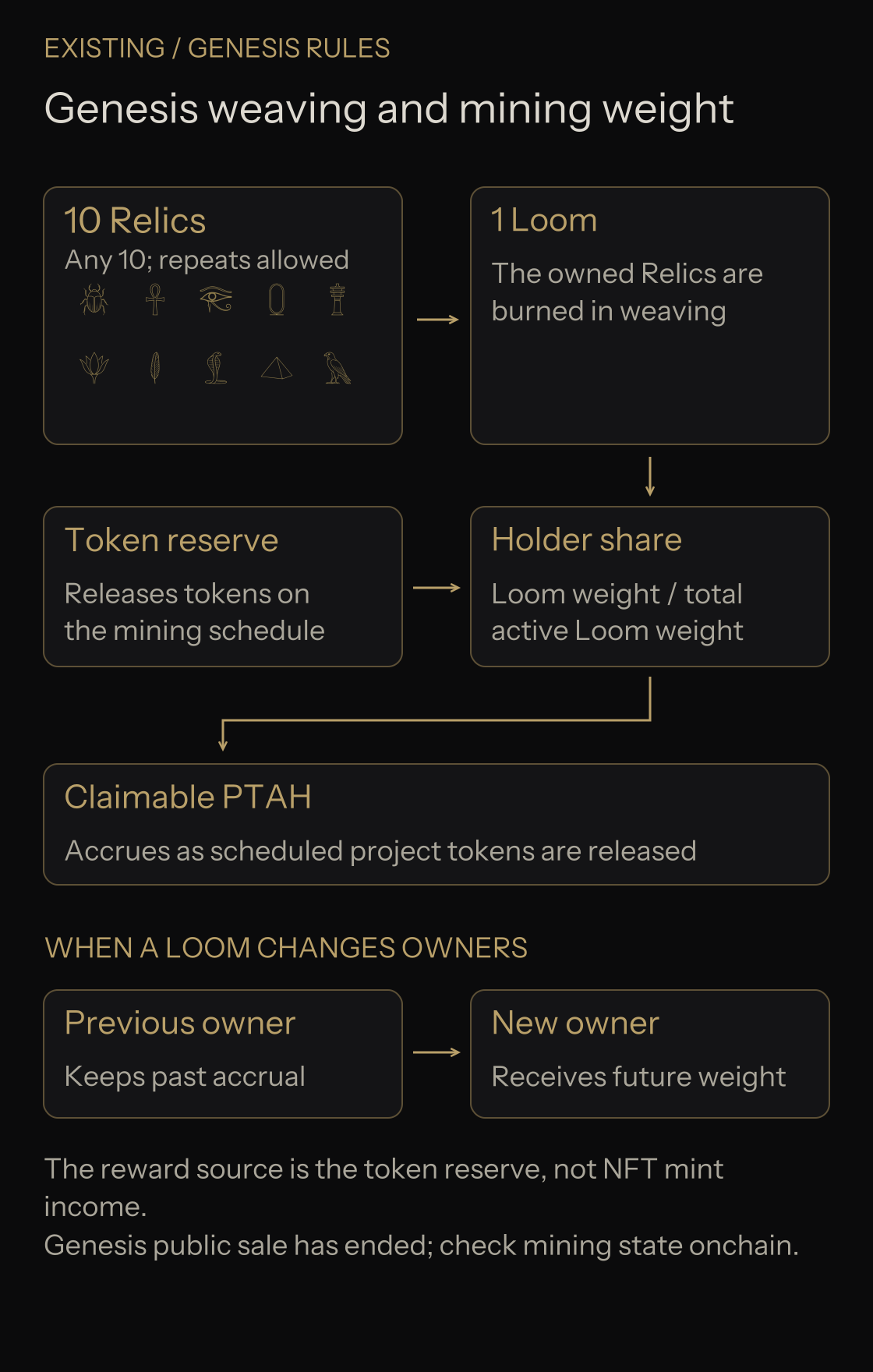
Any ten owned Genesis Relics can be woven into one Loom; different glyph types are not required. Scheduled project tokens, not mint income, fund accrual. Past accrual stays with the previous holder, and future Loom weight moves to the new holder.
EXISTING / GENESIS RULES Genesis weaving and mining weight
10 Relics
Any 10; repeats allowed
1 Loom
The owned Relics are burned in weaving
Token reserve
Releases tokens on the mining schedule
Holder share
Loom weight / total active Loom weight
Claimable PTAH
Accrues as scheduled project tokens are released
WHEN A LOOM CHANGES OWNERS
Previous owner
Keeps past accrual
New owner
Receives future weight
The reward source is the token reserve, not NFT mint income. Genesis public sale has ended; check mining state onchain.
Any ten owned Genesis Relics can be woven into one Loom; different glyph types are not required. Scheduled project tokens, not mint income, fund accrual. Past accrual stays with the previous holder, and future Loom weight moves to the new holder.
Open full-size vector diagram (opens in a new tab)Ptah Genesis has a 95,000-Relic public-sale allocation and a 5,000-Relic team reserve. Its public sale has ended. Existing Relics, Looms, weaving records, and the NFT market remain part of that original system; they are not recreated as a new platform project. Ten Genesis Relics weave into one Loom, and any ten owned Relics can be woven; ten different glyph types are not required.
A Genesis Loom receives a share of scheduled token emissions; it does not receive a share of NFT mint income. When a Loom changes owners, the mining contract first settles both accounts. Accrued rewards stay claimable by the previous holder, while the Loom's weight moves to the new holder for future accrual. Most of the Genesis token supply is reserved for mining, with the remainder held for the team. Mining timing and claimable amounts must be read from the active contracts and interface.
The plan is to move Genesis to a standard PTAH token with no added functions, and to create its pool with the same trading plug-in used by platform launches, completing the transition before mining begins. Genesis would then pay the platform trading tax like any other pool. This paper does not establish that the transition or pool creation has occurred. Confirmed addresses, pool terms, timing, and transition instructions must be announced separately, and the announced address is the one to rely on if two tokens with the same name appear in a wallet.
Genesis retains its existing contract permissions, including owner-controlled settings and emergency-withdrawal powers. The platform's restricted permissions and permanent liquidity-lock model must not be read as guarantees about the legacy NFT and mining contracts. Sharing a trading plug-in would not replace those contracts or erase their trust assumptions.
10. Development by verified milestones
The current foundation is the Genesis experience and its identity and wallet tools. The next milestones are the PTAH transition and pool, and the implementation and validation of the shared trading plug-in and the first launch templates. Deployment, parameter announcements, security review, and usable launch flows are required before templates can be presented as available.
Broader distribution of hook pools depends on external listing processes. The plan is to publish the plug-in source and seek PancakeSwap inclusion; neither acceptance nor third-party routing is guaranteed, and inclusion would not be an endorsement of safety. Factory, template, and lock source publication is planned separately and should not be assumed to have happened.
Later milestones include Founder NFT forging, further templates, payment conveniences, AI features, and community-proposed features. This is a direction of travel, without committed dates or a closed list. A released feature should be accompanied by its actual terms, contract addresses where relevant, and the evidence needed to inspect its behaviour.
11. Risks and limits
Token and NFT prices can fall substantially, and positions can become illiquid. Fixed supply, identity checks, launch taxes, and liquidity locks do not guarantee demand, honest creators, fair outcomes, or protection from manipulation. Opening taxes can consume most of an early purchase; review the live quote before authorising any transaction.
Creators can configure large reserves and team allocations. A project with concentrated holdings may see heavy selling after launch. Read the distribution shown on the project page before participating; a risk notice that is not shown does not mean a project is safe.
Smart-contract defects can cause permanent loss or lock funds. The platform contracts have no emergency-withdrawal function, which also removes some recovery options. A shared plug-in creates shared exposure across pools. This whitepaper makes no claim that the proposed contracts have completed an audit. Where source is not published, independent verification is limited.
A standard token can trade in other pools without the Ptah plug-in, so the designated pool's taxes do not apply everywhere. Priority windows may restrict contract wallets and aggregators until the window ends. Pool rules cannot be corrected after creation. BNB Chain, PancakeSwap, wallet services, identity registries, and infrastructure introduce external risks.
Fees, allocations, emission schedules, and permissions differ between launches. Readers should inspect the specific project and its current contracts. Project descriptions, identity labels, AI explanations, and website visibility are not endorsements or guarantees. Planned Founder NFT benefits and community-proposal incentives are not yet defined and may not be delivered as described.
This whitepaper describes Ptah's current foundation and proposed platform direction as of 23 October 2026. It is not an offer of securities, a promise of returns, or a substitute for the terms and deployed contracts of a specific launch. Nothing in it, including the description of $PTAH, Founder NFTs, or community-proposal incentives, constitutes a promise of returns, dividends, buybacks, or price. Proposed capabilities, parameters, and timelines may change before release. Participation involves the risk of loss.